

What Causes Tsunamis? Understanding the Forces Behind These Powerful Ocean Waves
Tsunamis are among the most powerful natural hazards on Earth. Here is a clear guide to the major causes of tsunamis — from undersea earthquakes to volcanic eruptions, landslides, and more.
Tsunamis are among the most powerful natural hazards on Earth. A single tsunami can cross entire oceans, impact multiple countries, and cause significant flooding along coastlines thousands of miles away from where it originated.
But what actually causes a tsunami? If you are new to the topic, start with our guide to what a tsunami is. Many people assume that all tsunamis are caused by earthquakes. While earthquakes are responsible for most tsunami events, they are not the only cause.
In this guide, we'll explore the major causes of tsunamis, how they form, and why some events generate devastating waves while others do not.
What Is a Tsunami?
A tsunami is a series of ocean waves generated when a large volume of water is suddenly displaced. Unlike ordinary waves created by wind, tsunamis originate from major disturbances occurring beneath or near the ocean.
When a large amount of water is pushed upward or downward, energy spreads outward across the ocean in all directions. This energy eventually reaches coastlines as tsunami waves.
The Most Common Cause: Undersea Earthquakes
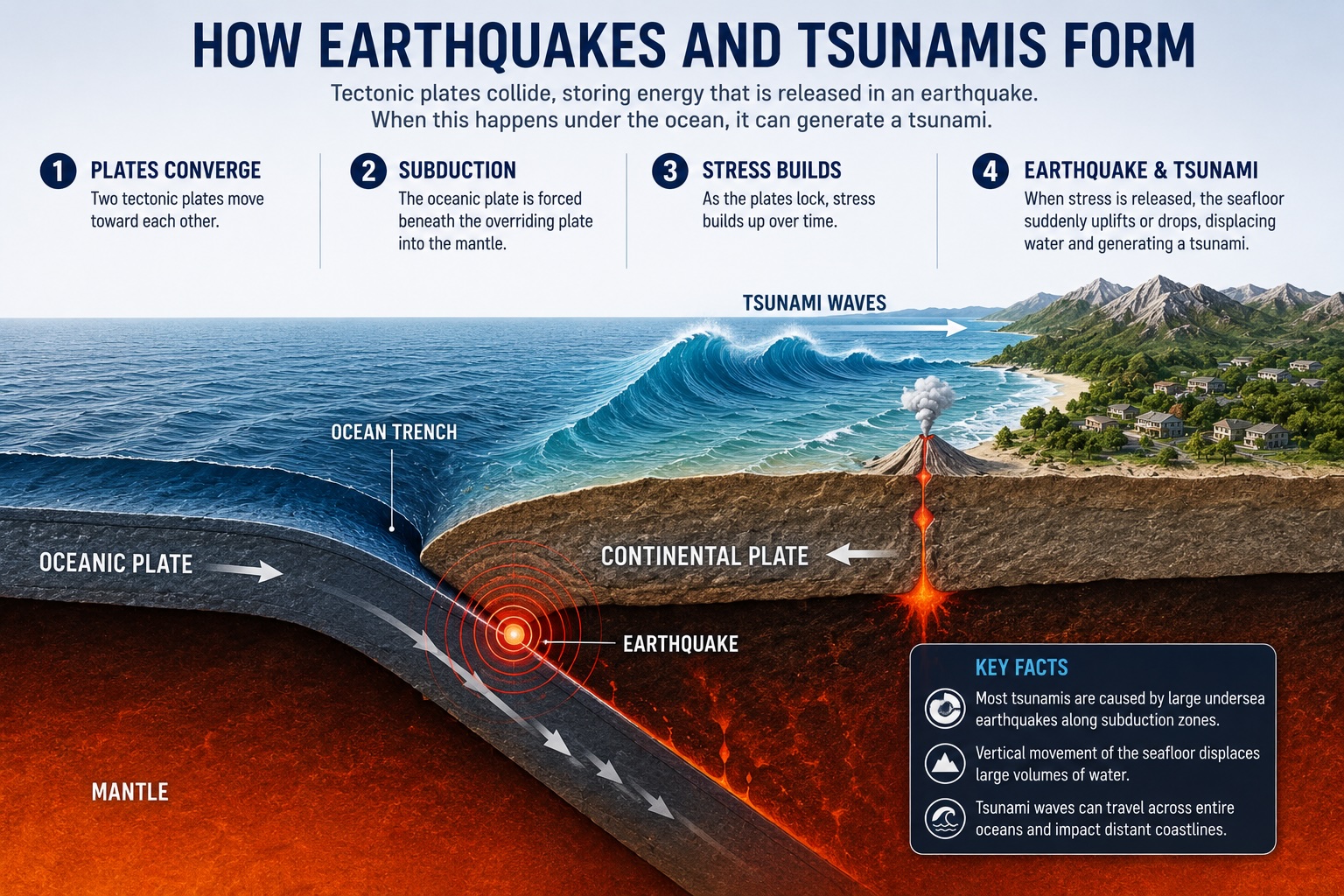
The majority of tsunamis are caused by large undersea earthquakes. These events typically occur near tectonic plate boundaries. When one tectonic plate suddenly shifts beneath another, parts of the ocean floor may rise or fall. This movement displaces enormous amounts of water and generates tsunami waves.
Several factors increase the likelihood that an earthquake will produce a tsunami: magnitude above 7.0, shallow earthquake depth, ocean-floor location, and significant vertical seafloor movement.
Not every earthquake generates a tsunami. In fact, most earthquakes do not.
How Earthquakes Create Tsunamis
Imagine lifting one end of a large container filled with water. The water immediately shifts in response. A similar process occurs during certain undersea earthquakes.
When the ocean floor suddenly moves upward, water above it is displaced, energy transfers into the ocean, and waves begin traveling outward. The larger the displacement, the greater the tsunami potential.
Volcanic Eruptions
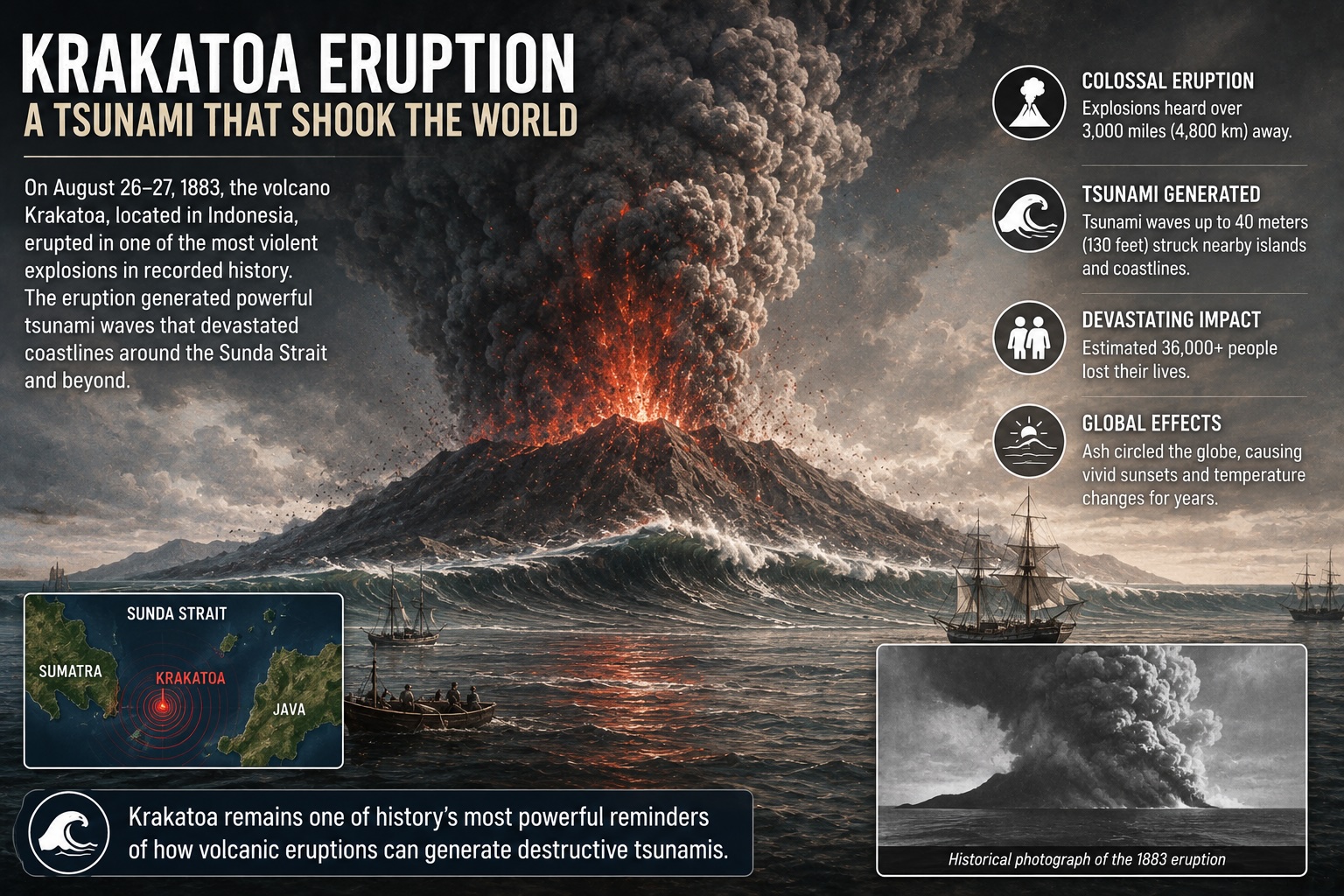
Volcanoes can also generate tsunamis. This may occur when part of a volcano collapses, underwater eruptions displace water, or volcanic explosions trigger landslides.
One of the most famous examples occurred in 1883 during the eruption of Krakatoa in Indonesia. The eruption generated destructive tsunami waves that affected nearby coastlines and caused widespread loss of life. More recently, the 2022 eruption of Hunga Tonga-Hunga Ha'apai generated tsunami activity across the Pacific Ocean.
Underwater Landslides
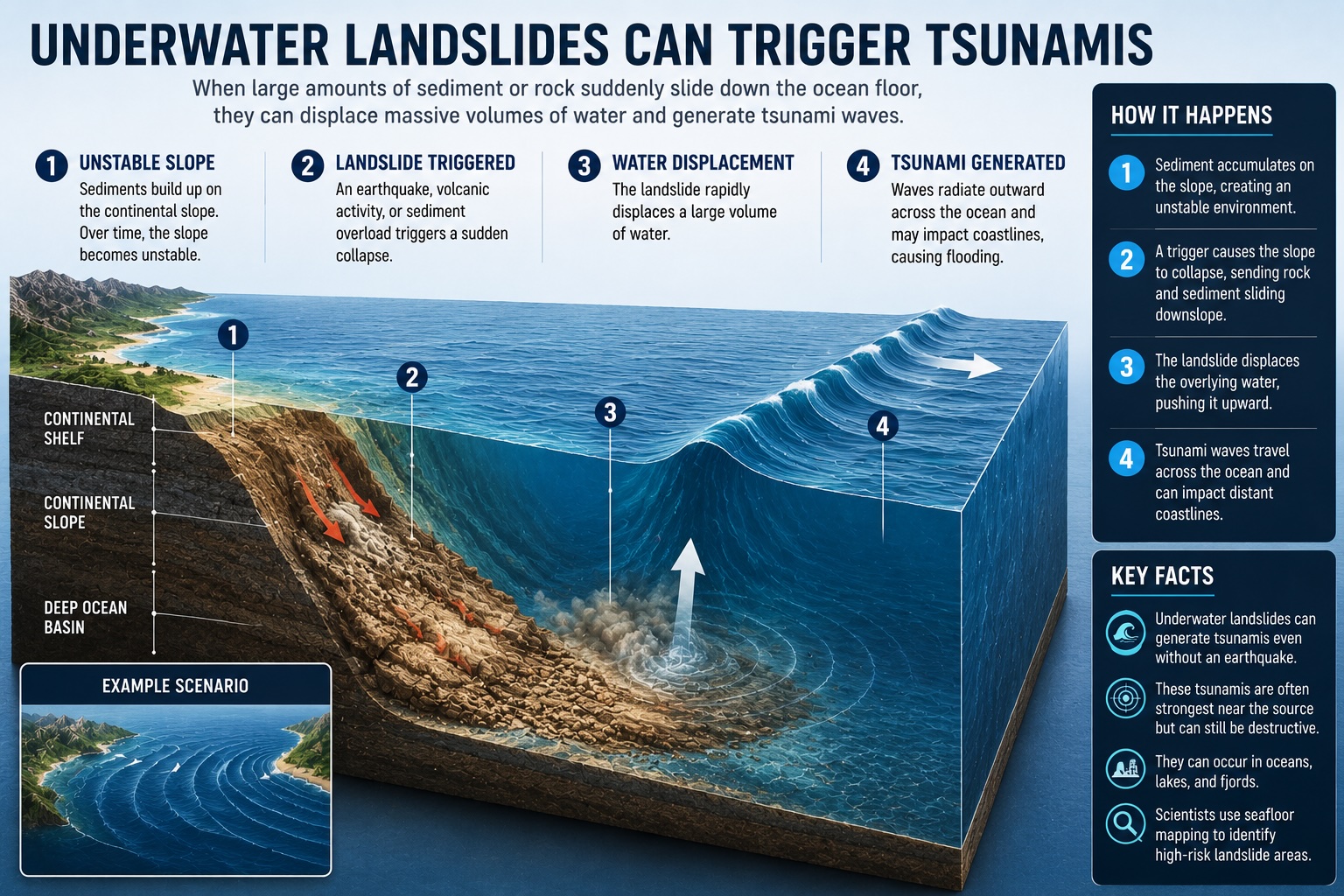
Large underwater landslides can produce tsunamis. These events occur when sediment or rock suddenly collapses beneath the ocean. Possible triggers include earthquakes, volcanic activity, and unstable seafloor conditions.
Although landslide-generated tsunamis often affect smaller geographic areas, they can be extremely dangerous close to the source.
Coastal Landslides
Not all tsunami-generating landslides occur underwater. Large coastal landslides that enter the ocean can also displace significant volumes of water. These events may generate local tsunamis capable of producing severe impacts nearby.
Glacier and Ice Collapse
In some regions, large ice masses entering the ocean can generate tsunami-like waves. These events are generally localized but can be significant in Alaska, Greenland, and Arctic regions. As climate conditions change, researchers continue monitoring these hazards.
Meteorite Impacts
Although extremely rare, large meteorite impacts into the ocean could generate enormous tsunamis. Scientists believe that asteroid impacts in Earth's distant past likely produced some of the largest tsunami events ever experienced. Fortunately, such events are extraordinarily uncommon.
Why Some Earthquakes Do Not Cause Tsunamis
Many people are surprised to learn that most earthquakes do not generate tsunamis. Several factors determine tsunami potential.
Location — earthquakes occurring on land generally do not produce tsunamis.
Depth — deep earthquakes are less likely to significantly disturb the ocean floor.
Type of Fault Movement — horizontal movement often displaces less water than vertical movement.
Magnitude — smaller earthquakes typically lack sufficient energy to generate major tsunamis.
Where Do Most Tsunami-Causing Earthquakes Occur?
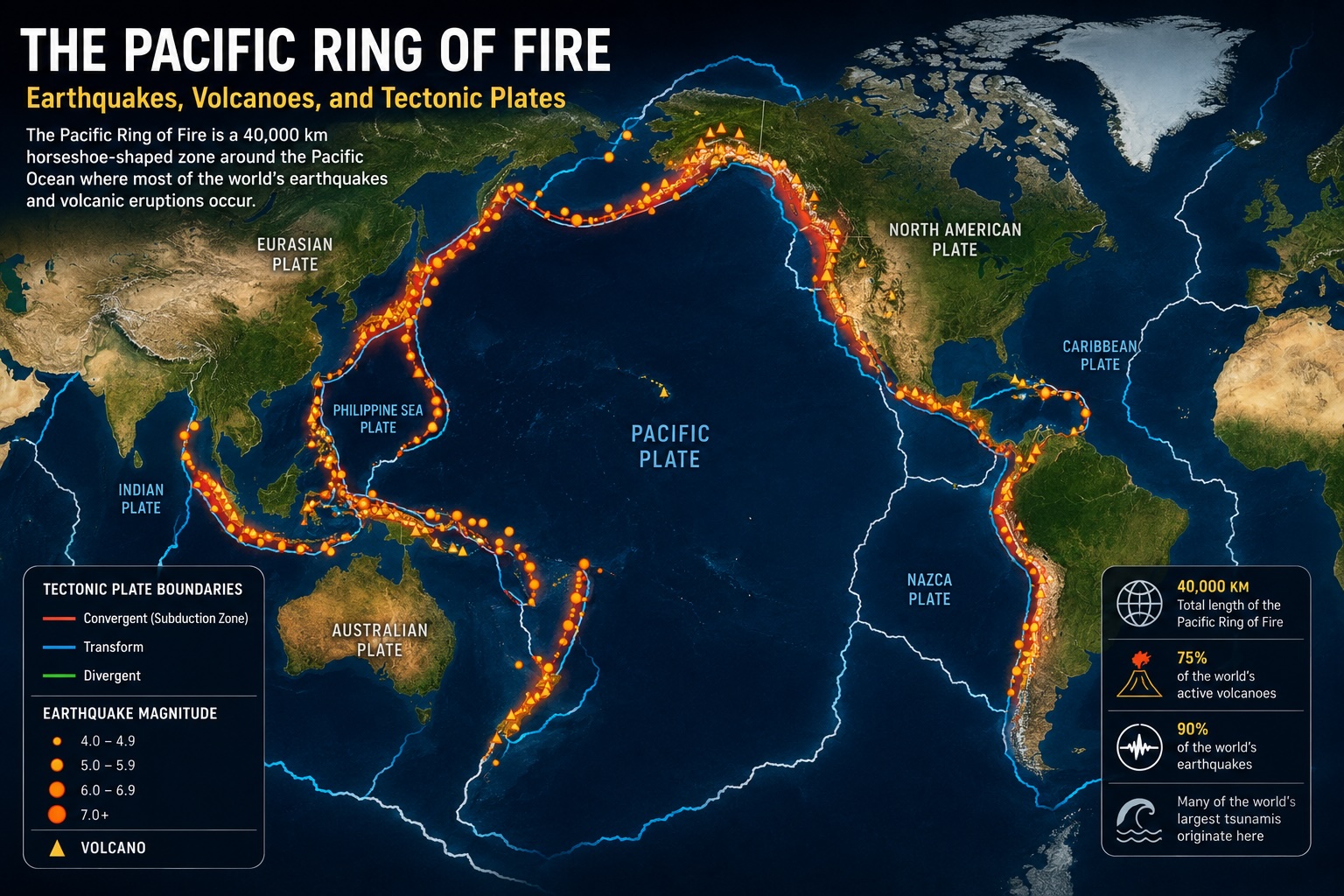
Many tsunami-generating earthquakes occur around the Pacific Ring of Fire. This region includes Alaska, Japan, New Zealand, Indonesia, Chile, and parts of North America.
The Ring of Fire contains numerous tectonic plate boundaries where large earthquakes frequently occur. As a result, many of the world's tsunami warning systems focus heavily on monitoring this region.
The Pacific Ring of Fire
The Ring of Fire is a belt of seismic and volcanic activity surrounding the Pacific Ocean. Approximately 90% of the world's earthquakes and many of history's most destructive tsunamis have originated within this region.
Can Scientists Predict Tsunamis?
Scientists cannot predict exactly when an earthquake or tsunami will occur. However, modern tsunami warning systems can detect earthquakes rapidly, monitor ocean conditions, estimate tsunami travel times, and issue warnings to affected regions.
These systems help provide valuable time for emergency response and evacuation.
Why Understanding Tsunami Causes Matters
Understanding what causes tsunamis helps people recognize natural warning signs, understand risk levels, appreciate warning systems, and improve tsunami preparedness.
The more people understand about tsunami formation, the better equipped they are to respond during emergencies.
How Tsunami Shield Supports Awareness
Tsunami Shield helps users stay informed by monitoring official tsunami alerts, earthquake activity, regional monitoring areas, and coastal preparedness information.
Access to reliable information can help individuals and families remain aware of developing hazards.
Stay Informed with Tsunami Shield
Tsunami Shield monitors official sources 24/7 and delivers verified alerts directly to your device — so you always have access to reliable information when it matters most.
Final Thoughts
Most tsunamis are caused by large undersea earthquakes, but volcanic eruptions, landslides, glacier collapses, and even meteorite impacts can also generate these powerful waves.
Although tsunamis are relatively rare, their impacts can be severe. Understanding how tsunamis form and what causes them is an important step toward improving awareness, preparedness, and coastal safety.
Knowledge remains one of the most effective tools for reducing risk and making informed decisions when natural hazards occur.
Frequently Asked Questions
What is the most common cause of tsunamis?
The majority of tsunamis are caused by large undersea earthquakes near tectonic plate boundaries, where sudden movement of the ocean floor displaces large volumes of water. Not all earthquakes generate tsunamis — key factors include the earthquake's magnitude, depth, location, and type of fault movement.
Can volcanoes cause tsunamis?
Yes. Volcanic eruptions can generate tsunamis through several mechanisms, including partial collapse of a volcano, underwater eruptions displacing water, and volcanic explosions triggering landslides. The 1883 eruption of Krakatoa and the 2022 Hunga Tonga-Hunga Ha'apai eruption are well-known examples.
Can landslides cause tsunamis?
Yes. Both underwater and coastal landslides can displace large volumes of water and generate tsunamis. Landslide-generated tsunamis often affect smaller geographic areas but can be extremely dangerous close to the source.
Where do most tsunamis occur?
Most tsunamis originate along the Pacific Ring of Fire, a belt of seismic and volcanic activity that includes Alaska, Japan, Indonesia, New Zealand, Chile, and parts of North America. This region contains numerous tectonic plate boundaries where large earthquakes frequently occur.
Read Next
Continue exploring related topics


